
Published November 21, 2026
5 Strategies Home Buyers Can Use to Negotiate Price


When it comes to purchasing a home, the first questions on buyers' minds usually revolve around price. No one wants to overpay for their home, but at the same time, no one wants to let their dream property go because their lowball offer backfired. Negotiating house price doesn't have to be fraught. Use these buyer-specific tactics to ensure you get the best possible deal on your new home.
Do Your Homework.
While it's tempting to enter a home price negotiation and fly by the seat of your pants, there's a lot to lose when you're operating on vibes alone. This is yet another instance where a trusted real estate agent will be your best friend. Prep work and market research go a long way in negotiating house price.
It's smart to do this homework for yourself, but your agent also has access to tools and information that you're not privy to. They're in the best position to get comps and to understand the ins and outs of the market. Your agent can lead the charge in these ways, but there are things that are outside of their hands.
It's in your best interest to get fully approved to buy the home ahead of time. A basic pre-approval only goes so far, as the initial estimate is based on self-reported information or a limited number of financial documents. Full approval means a mortgage underwriter has reviewed and signed off on the loan. This can go a long way in getting a seller to take your offer seriously.
Think Outside the (List Price) Box.
A home's list price may seem like the most important factor in a negotiation, but there are hundreds of points that can be considered when making an offer on a home. In fact, nearly every term in a contract could conceivably be negotiated. Obviously, going through a contract point by point is a sure way to get on a seller's bad side (and potentially lose the house in the process), but it's good to know that the sticker price isn't the only thing that can help buyers save big.
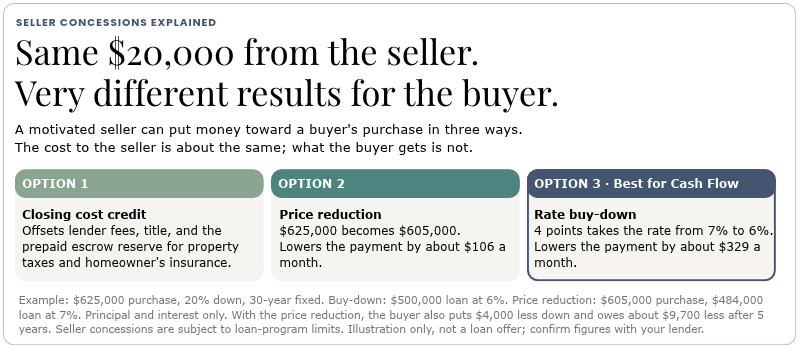
It's also smart to consider seller concessions. This is a category that includes having sellers pay for the closing costs, as well as another oft-overlooked option for lowering costs: rate buy-downs.
With respect to the former (and as the name suggests), a closing cost credit can mitigate some of the buyer's closing costs. If you're financing the home purchase, your lender may require a substantial reserve payment at closing to cover future property taxes and homeowners insurance, two things buyers often forget to consider. A closing cost credit from the seller can offset these costs as well as title and escrow fees.
Additionally, a motivated seller may be willing to contribute to a buyer's interest rate buy-down. This means that instead of negotiating more money off the list price, buyers can redirect funds from the seller and put them toward buying points that lower the interest rate on the mortgage.
This is a lesser-known option that many buyers fail to consider, and one that can pay off significantly in the long run. For the seller, for example, a $20,000 rate buy-down contribution nets the same to them as a $20,000 price reduction, but for the buyer, it means significantly more monthly cash in their pocket and a lower total cost of the loan.
Here's how a buy-down works: A one point buy-down costs 1% of the loan amount. Using a $500,000 loan as an example, the cost per point is $5,000. Each point decreases the buyer's interest rate by .25%. To get from a 7% interest rate to a 6% interest rate, the buy-down would cost four points or $20,000. Here's how that plays out over the first five years on a $625,000 home with 20% down.
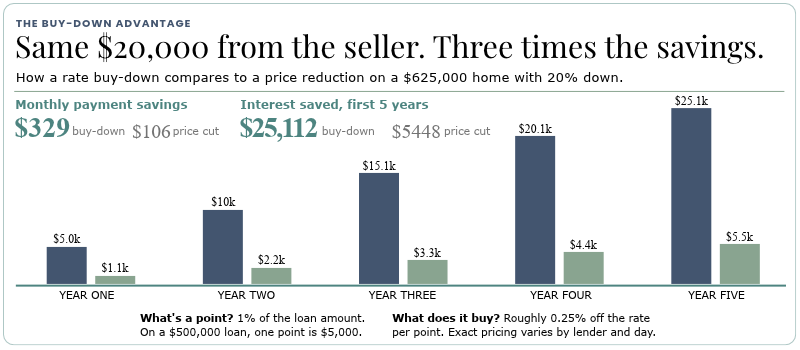
Ultimately, if a buyer wants to save in the long run, the buy-down is generally the better option. Keep in mind that a buy-down pays off over time, so it's worth less if you plan to refinance or sell within a few years. If it's more important to save money upfront to surpass private mortgage insurance (PMI) thresholds, avoid a jumbo loan or lessen the initial down payment, lowering the list price is the way to go.
Consider the Appeal of Flexibility.
Not all negotiations come down to price, as that's only one part of the overall equation. Sometimes you can win favor with a seller by offering greater flexibility. If a seller needs more time to move out, a rent-back agreement or a super-fast close, buyers can use these terms to their advantage.
Use Your Leverage Wisely.
Unless you're experiencing extenuating circumstances and feel you absolutely must, it's never wise to skip a general inspection. The inspection report also provides a significant means of leverage in a negotiation. Buyers should do their best to avoid getting caught up on minor fixes. It's far more beneficial to negotiate repair credits or seller-funded repairs on major issues, such as a failing HVAC or leaky roof.
Don't Negotiate Against Yourself.
Throughout the home buying process, the smartest thing you can do is avoid negotiating against yourself. This means keeping your emotions in check and your poker face on. This can be particularly challenging as home negotiations are a time when feelings can run high.
Although it's easy to get overly attached to a property, let your agent help you decide if and when it's in your best interest to walk away. Whenever engaging with the seller, allow your agent to do the talking. Never volunteer more concessions or sweeten the deal before you hear back about the initial offer. You want to leave space for the seller to say yes and give you exactly what you want.
Ready to work with agents who have the expertise to help you navigate the homebuying process from start to finish? Get in touch here.